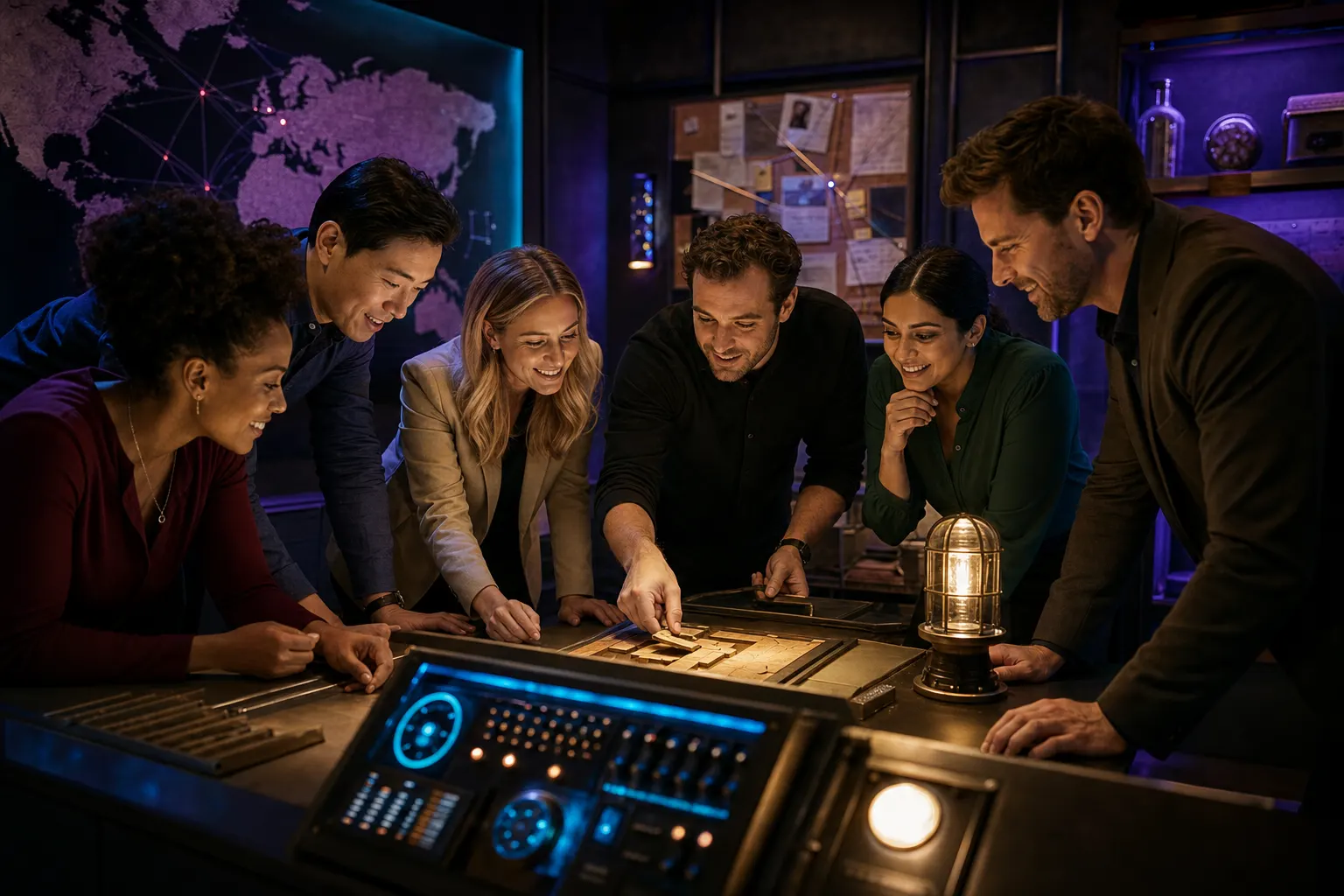
Looking for an escape room in Haifa and wondering what awaits inside? Whether this is your first game or you already have some experience, knowing the main puzzle types will help you settle in faster, work better as a team and enjoy the game more.
Part one covers logic challenges, numbers and codes, ciphers, hidden objects and hands-on mechanisms. Each type includes practical examples and a useful way to approach it, without spoiling any particular room.
This guide is for couples, families, groups of friends and workplace teams who want to arrive focused and ready for an escape room in Haifa.
01 · Connect the clues
Logic puzzles
Logic puzzles ask you to spot relationships between objects, draw conclusions from partial information, or put actions and items into the correct order.
Examples
- Arrange four objects on a shelf in the same order shown in a picture.
- Reconstruct a sequence of events using times displayed on clocks around the room.
- Combine several statements to determine who was where, who wore a particular colour and which possibilities can be ruled out.
How do you solve them?
Read every clue carefully, note the connections, eliminate impossible options and use a simple chart or list. Work step by step and say each conclusion aloud; another player may have the missing piece that completes it.
02 · Find the combination
Number and code puzzles
Many escape room puzzles use numbers, letters or both. The goal is often to derive a three- or four-digit combination that opens a lock or activates a mechanism.
Examples
- Select marked letters from books and turn them into numbers using their position in the alphabet.
- Convert a name or word into a numerical code with a key found in the room.
- Combine numbers shown on pictures, clocks, labels or notes into one code.
How do you solve them?
Identify where the numbers come from, look for a repeated pattern and use the clues to establish context and order. You may need simple arithmetic or a letter-to-number conversion. A small ordering mistake changes the whole code, so check each step.
03 · Decode the message
Ciphers and cryptography
Encrypted messages often appear on walls, notes and screens, and sometimes inside audio recordings. The first task is to recognise the system and locate the correct key.
Examples
- A Caesar cipher, where each letter shifts several places forward or back.
- Morse code, using dots and dashes to represent letters and numbers.
- The Pigpen cipher, where symbols represent letters by their position in a grid.
- Reversed words or messages hidden inside ordinary text or on objects.
How do you solve them?
Look for a decoder sheet or key in the room and compare the symbols with other clues. Divide the work: one player reads while another decodes. No previous knowledge of cryptography is required because the game supplies the tools you need.
05 · The room responds
Interacting with objects
Escape rooms often combine mental puzzles with light physical tasks involving movement, touch and coordination between players.
Examples
- Connect different coloured wires in the correct order to activate a system.
- Adjust mirrors until a beam reaches a particular point.
- Fill a container to a set level to trigger a sensor or open a secret door.
How do you solve them?
Watch how the room reacts when an object is moved, placed or filled. Trial and error is part of the game when you act gently and follow the briefing. Sometimes two players must operate separate elements at once, making communication and role-sharing essential.
06 · Turn knowledge into teamwork
What should you remember before the game?
Escape rooms combine curiosity, thinking, teamwork and fun. The more puzzle types you recognise and the more freely you share each discovery, the easier it becomes to connect the details and progress. No one person needs every skill; the team’s real advantage is the mix of its members’ strengths.
Looking for your next escape room in Haifa?
Quest Room offers eight different games, each with its own story, atmosphere and challenges for couples, families, friends and workplace teams.
Ready to put your skills to the test?
Choose the story and difficulty that suit your group, book a time and step into an experience where any detail could become the next clue.
Choose your next escape room07 · From knowledge to experience
Quest Room’s escape rooms in Haifa
Quest Room opened Haifa’s first escape room and was among the early operators to develop the format in northern Israel. Today the complex has eight escape-room games at one address, placing it among Israel’s largest and most varied escape-room complexes and among the most prominent in the north. In each game, a team enters a story world for about 60 minutes, searches for clues, deciphers codes and uses only items intended for play, in line with the briefing, to complete the mission.
These games have several names — escape room, puzzle room or Quest Room — but all describe a team adventure to share with friends, family or a partner.
The complex is easy to reach whether you are coming from Haifa, Nesher, the Krayot, Zikhron Ya’akov, elsewhere in northern Israel or the centre of the country. Choose a room and book a game, or buy a gift card for friends or family.